
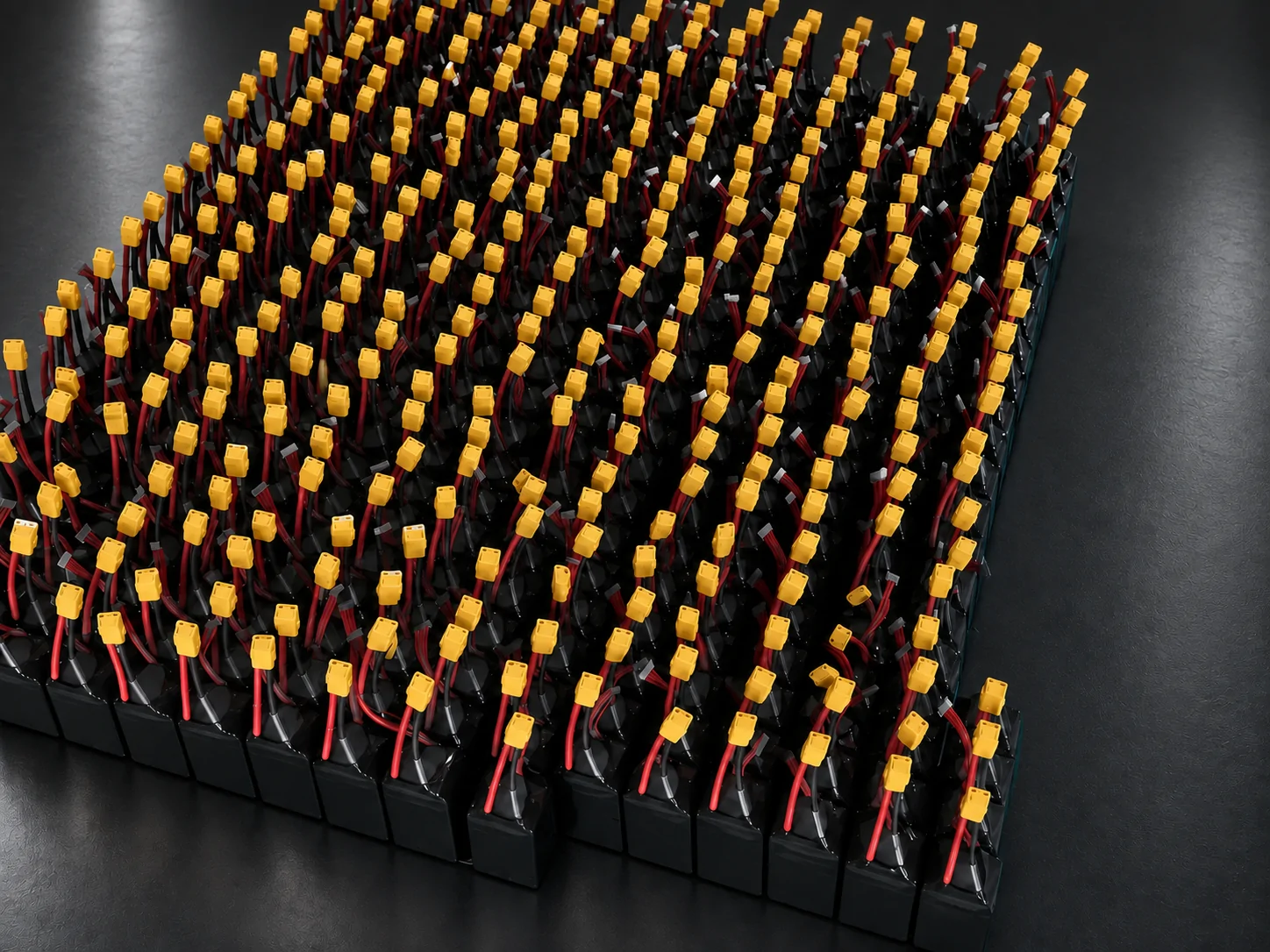
Select for loaded voltage, current profile and usable energy together. A capacity label and a C-rating cannot establish flight performance or safe failsafe settings.
A warning before the expected capacity is used.
An ArduPilot forum user described early low-voltage failsafes and asked why the battery sagged when average current was below its advertised C-rating. The thread raised both battery and aircraft questions. The discussion frames the measurement questions explored here. Read the original discussion.
For a professional program, the useful question is more specific: can this complete battery maintain the equipment’s required voltage during the mission, including the demanding part near the intended reserve?
A current label does not describe the mission.
A C-rate expresses current relative to rated Ah capacity. It does not, by itself, supply the loaded-voltage curve, pulse duration, thermal conditions or end-of-discharge behavior needed for a mission review. Ask for the manufacturer’s actual rating conditions rather than assuming every printed C value uses the same definition. Keysight: battery fundamentals and C-rate.
Resistance testing also has a defined time and method. A short pulse result should not be read as proof that the same load can be held throughout a flight. HIOKI’s explanation of AC and DC resistance measurements makes this distinction important when interpreting a cell or pack report. HIOKI: resistance measurement methods.
Less voltage can mean more current.
Electrical demand: 1,200 W
At 24 V: 1,200 / 24 = 50 A
At 20 V: 1,200 / 20 = 60 A
The same electrical power needs 20% more current in this example. This example assumes constant power. Actual aircraft demand varies with propulsion, flight conditions and controls.
This is why one average-current number is insufficient. Compare voltage and current at the same time, then consider whether the event is a brief transient or sustained demand. Include the power path between the battery and the measurement point.
Build a diagnosis from the record.
| Observation | Question to resolve |
|---|---|
| Telemetry and a reference measurement disagree | Are the monitor configuration and calibration correct? |
| Voltage falls during high-current events | What were the current, duration, starting charge state and temperature? |
| Battery and equipment-side voltages differ | How much drop belongs to connectors, wiring and the sensing boundary? |
| Early warning despite nominal capacity remaining | Is usable energy limited by the required loaded voltage? |
Compare the full operating record with controlled measurements to distinguish battery, wiring and telemetry issues. Use an appropriately controlled test plan and qualified review for high-current or flight-critical checks.
Control settings cannot create battery capability.
ArduPilot distinguishes current limiting from voltage scaling. Current limiting can reduce available throttle, while voltage scaling adjusts attitude-control gains as supply voltage changes. Neither is a substitute for adequate battery and propulsion capability. ArduPilot: current limiting and voltage scaling.
The battery failsafe can act on voltage or estimated remaining capacity, and its voltage source can be raw or sag-corrected. A threshold must therefore be read together with its source, timer, action and firmware configuration. Do not copy a threshold from another aircraft or disable the failsafe to recover flight time. ArduPilot: battery failsafe.
What to send for battery selection.
Share the information you have. Open technical questions can be resolved during the first review.
- Aircraft type, installed battery mass allowance and available envelope.
- Permitted supply-voltage range and the current battery configuration.
- Representative current and voltage logs, with peak duration and the intended mission explained.
- Required flight duration and reserve policy, including the most demanding planned operating conditions.
- Charging workflow, temperature range, connectors and battery handling constraints.
- Sample quantity and expected production volume.
The selection output should connect a candidate battery to a defined operating profile and verification plan.
Sources and calculation notes.
The ArduPilot discussion identifies a real reader problem. The technical sources are the official ArduPilot documentation and HIOKI’s measurement explanation, linked beside the relevant claims. The calculation and review checklist are editorial synthesis. Aircraft-specific settings and flight-critical decisions require qualified review.